Dangerous Creatures
Army Ant
Army Ant
Eciton burchellii

30 million strong and always hungry—nothing escapes the army ant swarm!

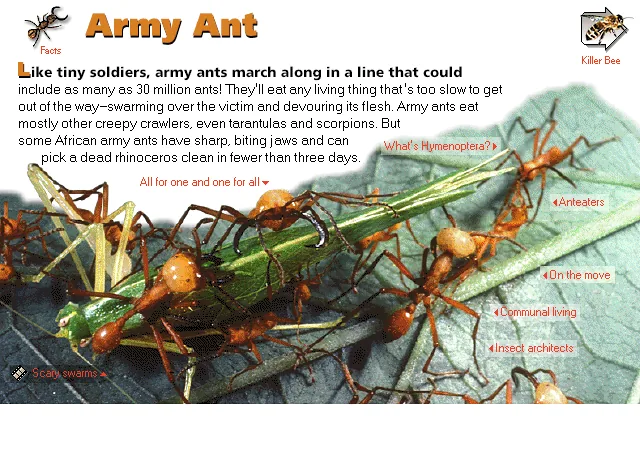
Like tiny soldiers, army ants march along in a line that could include as many as 30 million ants! They'll eat any living thing that's too slow to get out of the way—swarming over the victim and devouring its flesh. Army ants eat mostly other creepy crawlers, even tarantulas and scorpions. But some African army ants have sharp, biting jaws and can pick a dead rhinoceros clean in fewer than three days.

Get closer

All for one and one for all

All for one and one for all

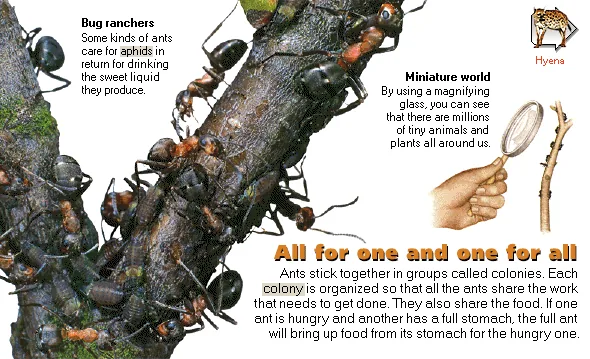
Ants stick together in groups called colonies. Each colony is organized so that all the ants share the work that needs to get done. They also share the food. If one ant is hungry and another has a full stomach, the full ant will bring up food from its stomach for the hungry one.

Bug ranchersSome kinds of ants care for aphids in return for drinking the sweet liquid they produce.
Miniature worldBy using a magnifying glass, you can see that there are millions of tiny animals and plants all around us.
What's Hymenoptera?

What's Hymenoptera?

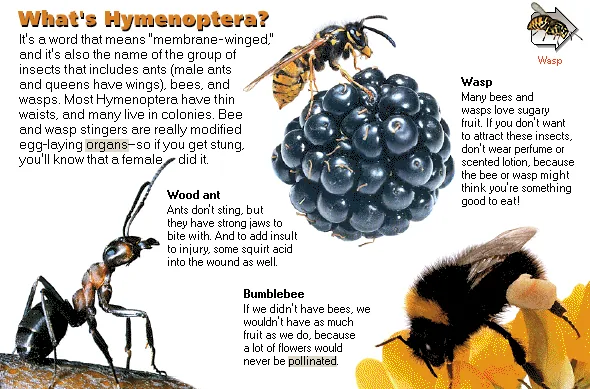
It's a word that means "membrane-winged," and it's also the name of the group of insects that includes ants (male ants and queens have wings), bees, and wasps. Most Hymenoptera have thin waists, and many live in colonies. Bee and wasp stingers are really modified egg-laying organs—so if you get stung, you'll know that a female did it.

Wood antAnts don't sting, but they have strong jaws to bite with. And to add insult to injury, some squirt acid into the wound as well.
WaspMany bees and wasps love sugary fruit. If you don't want to attract these insects, don't wear perfume or scented lotion, because the bee or wasp might think you're something good to eat!
BumblebeeIf we didn't have bees, we wouldn't have as much fruit as we do, because a lot of flowers would never be pollinated.
Communal living

Communal living

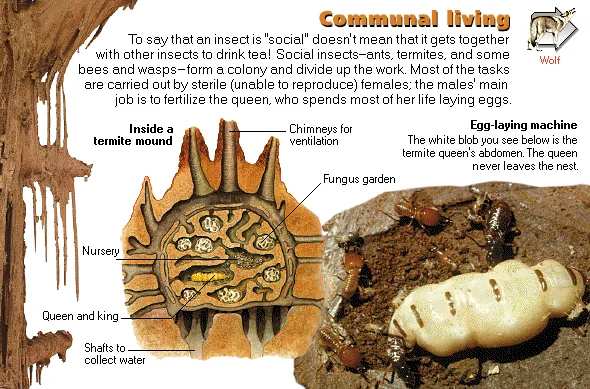
To say that an insect is "social" doesn't mean that it gets together with other insects to drink tea! Social insects—ants, termites, and some bees and wasps—form a colony and divide up the work. Most of the tasks are carried out by sterile (unable to reproduce) females; the males' main job is to fertilize the queen, who spends most of her life laying eggs.

Egg-laying machineThe white blob you see below is the termite queen's abdomen. The queen never leaves the nest.
Insect architects

Insect architects

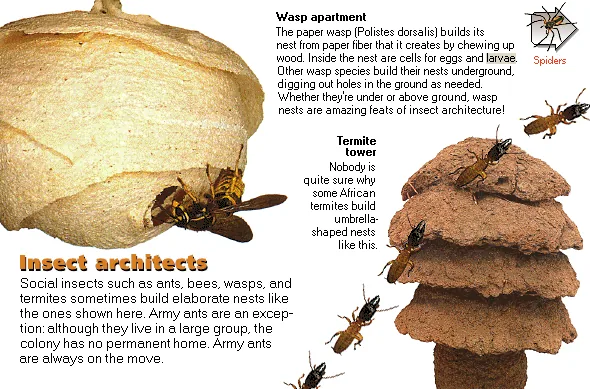
Social insects such as ants, bees, wasps, and termites sometimes build elaborate nests like the ones shown here. Army ants are an exception: although they live in a large group, the colony has no permanent home. Army ants are always on the move.

Wasp apartmentThe paper wasp (Polistes dorsalis) builds its nest from paper fiber that it creates by chewing up wood. Inside the nest are cells for eggs and larvae. Other wasp species build their nests underground, digging out holes in the ground as needed. Whether they're under or above ground, wasp nests are amazing feats of insect architecture!
Termite towerNobody is quite sure why some African termites build umbrella-shaped nests like this.
On the move

On the move

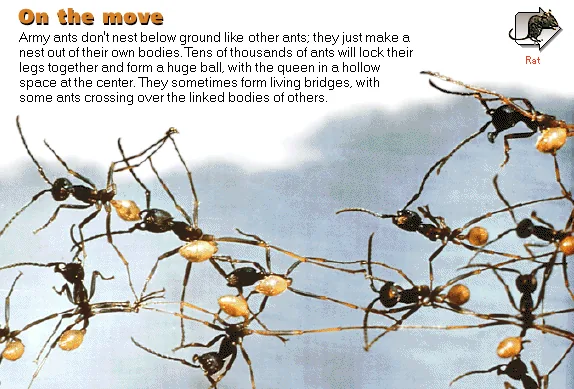
Army ants don't nest below ground like other ants; they just make a nest out of their own bodies. Tens of thousands of ants will lock their legs together and form a huge ball, with the queen in a hollow space at the center. They sometimes form living bridges, with some ants crossing over the linked bodies of others.

Anteaters

Anteaters

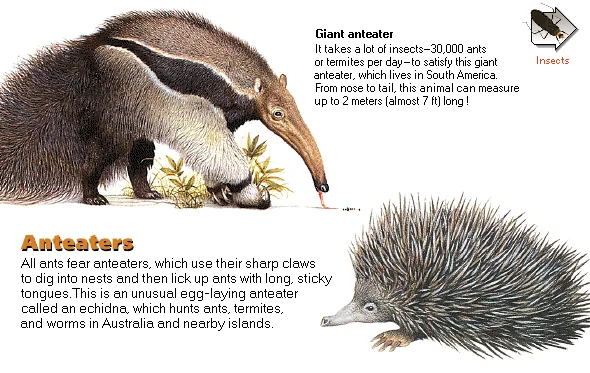
All ants fear anteaters, which use their sharp claws to dig into nests and then lick up ants with long, sticky tongues. This is an unusual egg-laying anteater called an echidna, which hunts ants, termites, and worms in Australia and nearby islands.

Giant anteaterIt takes a lot of insects—30,000 ants or termites per day—to satisfy this giant anteater, which lives in South America. From nose to tail, this animal can measure up to 2 meters (almost 7 ft) long!

Watch

Scary swarms — Ants are too delicate to tackle larger animals on their own. So they attack in swarms, biting or stinging by the hundreds. African army ants (also known as "driver" or "soldier" ants) have vicious jaws that look like curved swords.

Source: Microsoft Dangerous Creatures (1994) CD-ROM. Text liberated from original screen art; images & clip restored from disc. Original media is Microsoft/supplier copyright — placeholder pending swap to open-licensed assets. Credits & Acknowledgements →