Dangerous Creatures
Boa
Boa
Boa constrictor

The world's ultimate hugger — if it hugs you, you can't breathe!

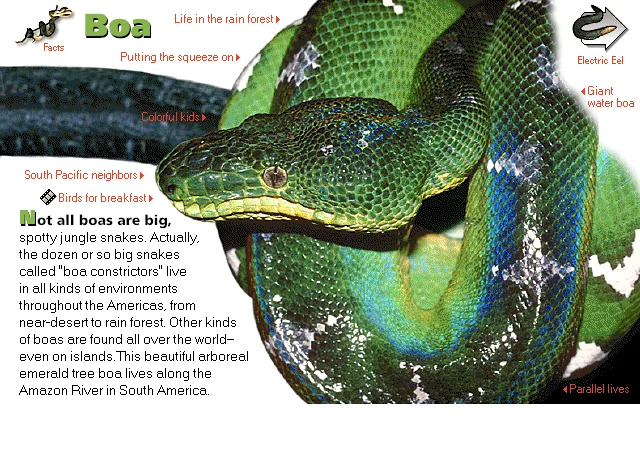
Not all boas are big, spotty jungle snakes. Actually, the dozen or so big snakes called "boa constrictors" live in all kinds of environments throughout the Americas, from near-desert to rain forest. Other kinds of boas are found all over the world—even on islands. This beautiful arboreal emerald tree boa lives along the Amazon River in South America.

Get closer

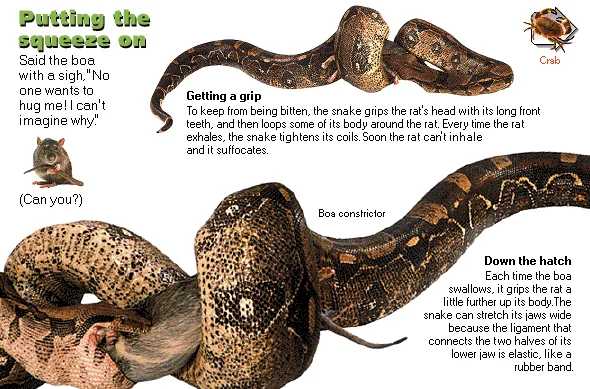
Putting the squeeze on

Putting the squeeze on

Getting a grip: To keep from being bitten, the snake grips the rat's head with its long front teeth, and then loops some of its body around the rat. Every time the rat exhales, the snake tightens its coils. Soon the rat can't inhale and it suffocates. Down the hatch: Each time the boa swallows, it grips the rat a little further up its body. The snake can stretch its jaws wide because the ligament that connects the two halves of its lower jaw is elastic, like a rubber band.
Parallel lives

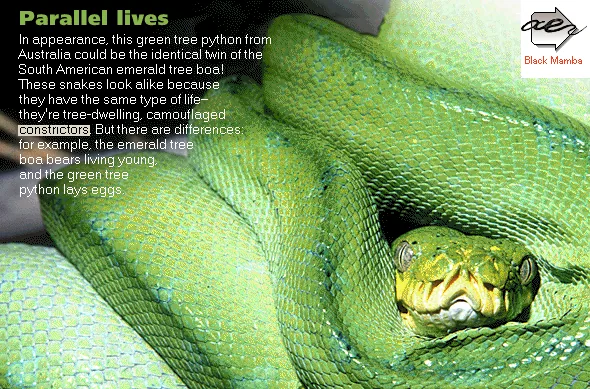
Parallel lives

In appearance, this green tree python from Australia could be the identical twin of the South American emerald tree boa! These snakes look alike because they have the same type of life—they're tree-dwelling, camouflaged constrictors. But there are differences: for example, the emerald tree boa bears living young, and the green tree python lays eggs.

Giant water boa

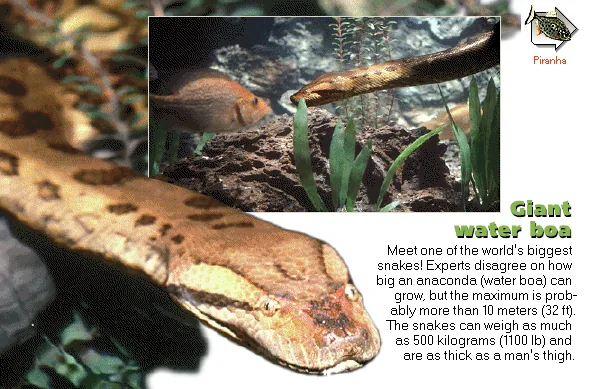
Giant water boa

Meet one of the world's biggest snakes! Experts disagree on how big an anaconda (water boa) can grow, but the maximum is probably more than 10 meters (32 ft). The snakes can weigh as much as 500 kilograms (1100 lb) and are as thick as a man's thigh.

South Pacific neighbors

South Pacific neighbors

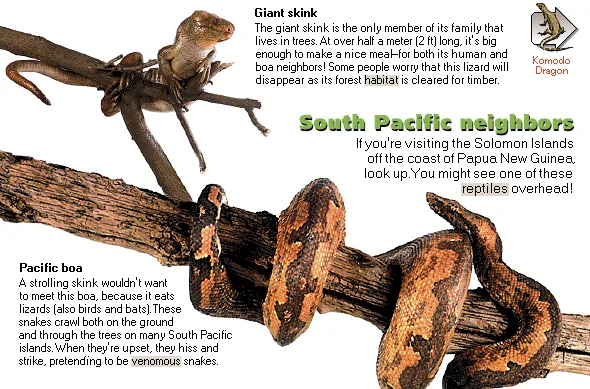
If you're visiting the Solomon Islands off the coast of Papua New Guinea, look up. You might see one of these reptiles overhead!

Giant skinkThe giant skink is the only member of its family that lives in trees. At over half a meter (2 ft) long, it's big enough to make a nice meal—for both its human and boa neighbors! Some people worry that this lizard will disappear as its forest habitat is cleared for timber.
Pacific boaA strolling skink wouldn't want to meet this boa, because it eats lizards (also birds and bats). These snakes crawl both on the ground and through the trees on many South Pacific islands. When they're upset, they hiss and strike, pretending to be venomous snakes.
Life in the rain forest

Life in the rain forest

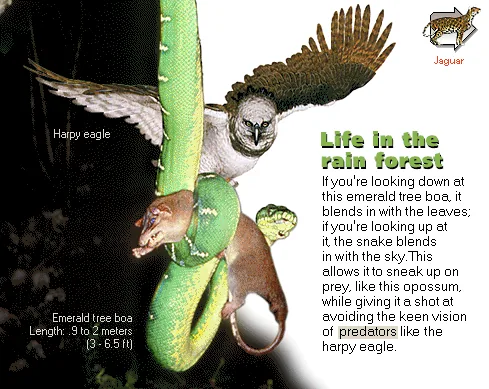
If you're looking down at this emerald tree boa, it blends in with the leaves; if you're looking up at it, the snake blends in with the sky. This allows it to sneak up on prey, like this opossum, while giving it a shot at avoiding the keen vision of predators like the harpy eagle.

Emerald tree boaLength: .9 to 2 meters (3 - 6.5 ft)
Colorful kids

Colorful kids

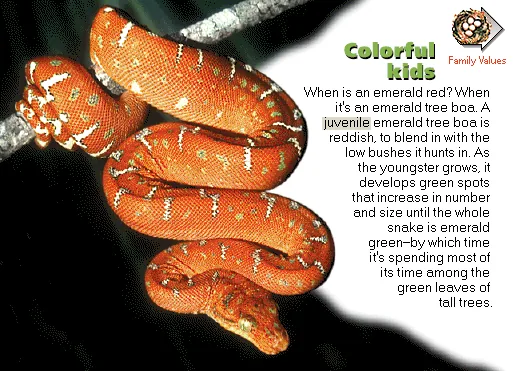
When is an emerald red? When it's an emerald tree boa. A juvenile emerald tree boa is reddish, to blend in with the low bushes it hunts in. As the youngster grows, it develops green spots that increase in number and size until the whole snake is emerald green—by which time it's spending most of its time among the green leaves of tall trees.

Watch

Birds for breakfast — Adult emerald tree boas do most of their hunting in trees. They'll eat whatever they can catch among the branches—frogs and lizards, small mammals, and of course, birds. These snakes wrap their tails around a branch to anchor themselves while capturing or eating their prey.

Source: Microsoft Dangerous Creatures (1994) CD-ROM. Text liberated from original screen art; images & clip restored from disc. Original media is Microsoft/supplier copyright — placeholder pending swap to open-licensed assets. Credits & Acknowledgements →