Dangerous Creatures
Great White Shark
Great White Shark
Carcharodon carcharias

The ocean's ultimate predator — built to bite, built to last.

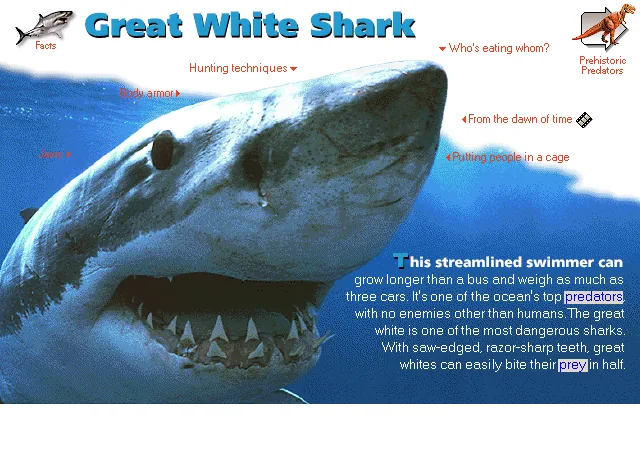
This streamlined swimmer can grow longer than a bus and weigh as much as three cars. It's one of the ocean's top predators, with no enemies other than humans. The great white is one of the most dangerous sharks. With saw-edged, razor-sharp teeth, great whites can easily bite their prey in half.

Get closer

Hunting techniques

Hunting techniques

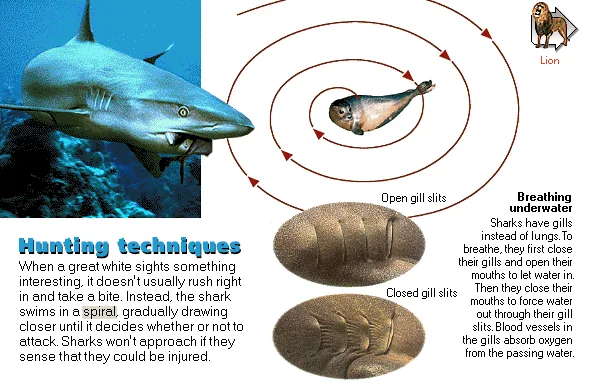
When a great white sights something interesting, it doesn't usually rush right in and take a bite. Instead, the shark swims in a spiral, gradually drawing closer until it decides whether or not to attack. Sharks won't approach if they sense that they could be injured.

Breathing underwaterSharks have gills instead of lungs. To breathe, they first close their gills and open their mouths to let water in. Then they close their mouths to force water out through their gill slits. Blood vessels in the gills absorb oxygen from the passing water.
Jaws

Jaws

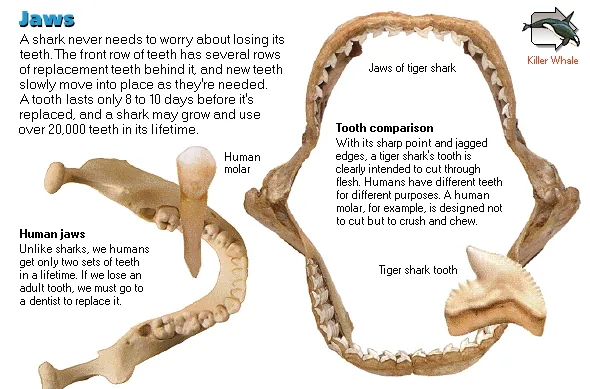
A shark never needs to worry about losing its teeth. The front row of teeth has several rows of replacement teeth behind it, and new teeth slowly move into place as they're needed. A tooth lasts only 8 to 10 days before it's replaced, and a shark may grow and use over 20,000 teeth in its lifetime.

Human jawsUnlike sharks, we humans get only two sets of teeth in a lifetime. If we lose an adult tooth, we must go to a dentist to replace it.
Tooth comparisonWith its sharp point and jagged edges, a tiger shark's tooth is clearly intended to cut through flesh. Humans have different teeth for different purposes. A human molar, for example, is designed not to cut but to crush and chew.
Putting people in a cage

Putting people in a cage

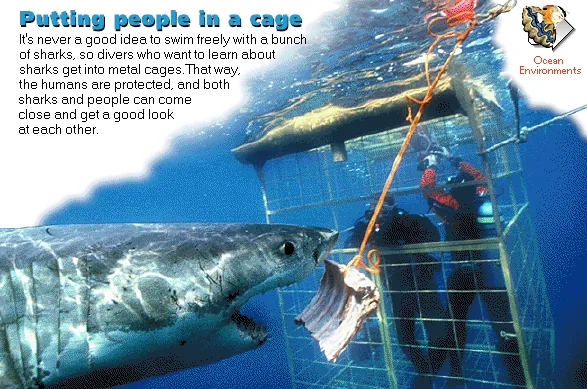
It's never a good idea to swim freely with a bunch of sharks, so divers who want to learn about sharks get into metal cages. That way, the humans are protected, and both sharks and people can come close and get a good look at each other.

Body armor

Body armor

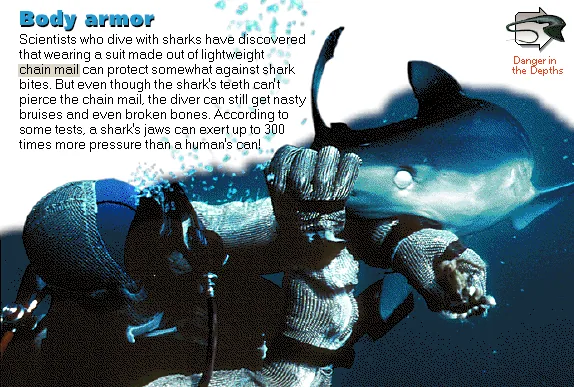
Scientists who dive with sharks have discovered that wearing a suit made out of lightweight chain mail can protect somewhat against shark bites. But even though the shark's teeth can't pierce the chain mail, the diver can still get nasty bruises and even broken bones. According to some tests, a shark's jaws can exert up to 300 times more pressure than a human's can!

Who's eating whom?

Who's eating whom?

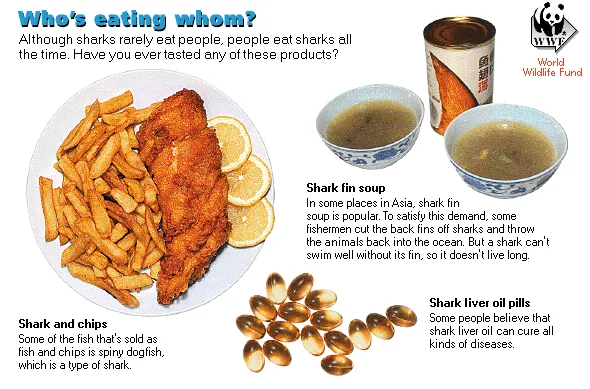
Although sharks rarely eat people, people eat sharks all the time. Have you ever tasted any of these products?

Shark and chipsSome of the fish that's sold as fish and chips is spiny dogfish, which is a type of shark.
Shark fin soupIn some places in Asia, shark fin soup is popular. To satisfy this demand, some fishermen cut the back fins off sharks and throw the animals back into the ocean. But a shark can't swim well without its fin, so it doesn't live long.
Shark liver oil pillsSome people believe that shark liver oil can cure all kinds of diseases.

Watch

From the dawn of time — Sharks have been around for millions of years, and prehistoric sharks were even bigger than modern sharks! Based on the size of its teeth, one ancient shark called Carcharodon megalodon is estimated to have been 13.2 meters (43 ft) long!

Source: Microsoft Dangerous Creatures (1994) CD-ROM. Text liberated from original screen art; images & clip restored from disc. Original media is Microsoft/supplier copyright — placeholder pending swap to open-licensed assets. Credits & Acknowledgements →