Dangerous Creatures
Killer Bee
Killer Bee
Apis mellifera scutellata

One sting is bad — a swarm of millions is terrifying.

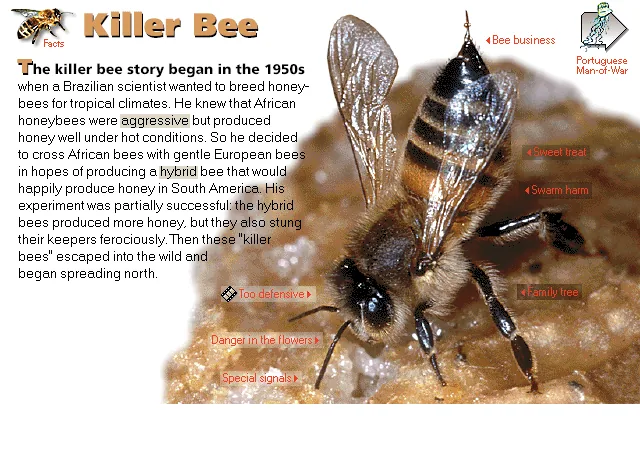
The killer bee story began in the 1950s when a Brazilian scientist wanted to breed honeybees for tropical climates. He knew that African honeybees were aggressive but produced honey well under hot conditions. So he decided to cross African bees with gentle European bees in hopes of producing a hybrid bee that would happily produce honey in South America. His experiment was partially successful: the hybrid bees produced more honey, but they also stung their keepers ferociously. Then these "killer bees" escaped into the wild and began spreading north.

Get closer

Family tree

Family tree

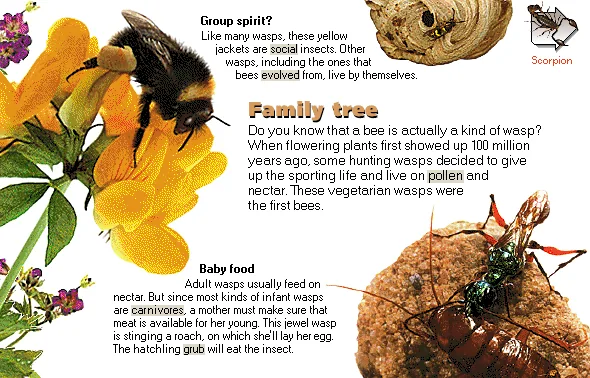
Do you know that a bee is actually a kind of wasp? When flowering plants first showed up 100 million years ago, some hunting wasps decided to give up the sporting life and live on pollen and nectar. These vegetarian wasps were the first bees.

Group spirit?Like many wasps, these yellow jackets are social insects. Other wasps, including the ones that bees evolved from, live by themselves.
Baby foodAdult wasps usually feed on nectar. But since most kinds of infant wasps are carnivores, a mother must make sure that meat is available for her young. This jewel wasp is stinging a roach, on which she'll lay her egg. The hatchling grub will eat the insect.
Swarm harm

Swarm harm

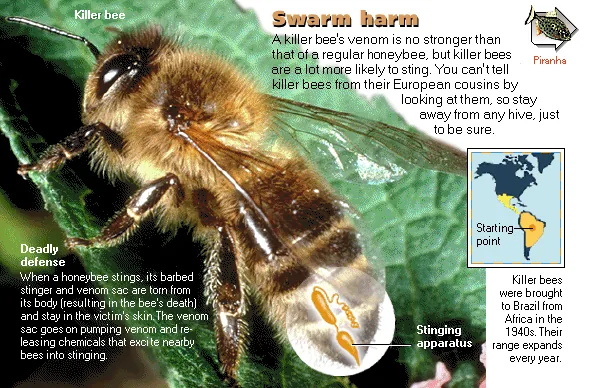
A killer bee's venom is no stronger than that of a regular honeybee, but killer bees are a lot more likely to sting. You can't tell killer bees from their European cousins by looking at them, so stay away from any hive, just to be sure.

Deadly defenseWhen a honeybee stings, its barbed stinger and venom sac are torn from its body (resulting in the bee's death) and stay in the victim's skin. The venom sac goes on pumping venom and releasing chemicals that excite nearby bees into stinging.
Starting pointKiller bees were brought to Brazil from Africa in the 1940s. Their range expands every year.
Sweet treat

Sweet treat

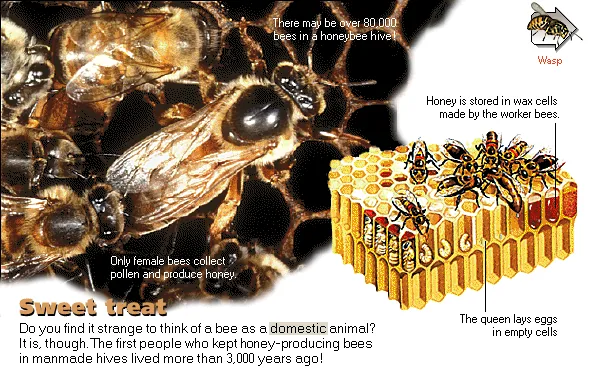
Do you find it strange to think of a bee as a domestic animal? It is, though. The first people who kept honey-producing bees in manmade hives lived more than 3,000 years ago!

Danger in the flowers

Danger in the flowers

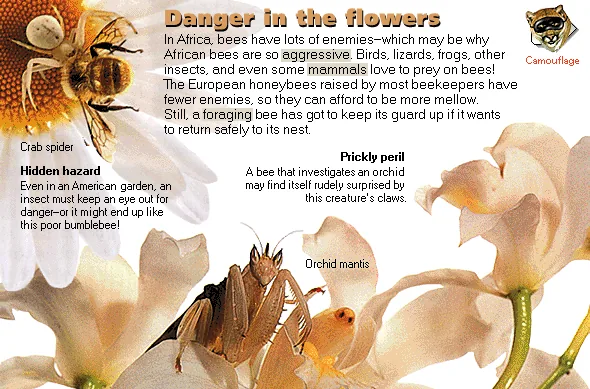
In Africa, bees have lots of enemies—which may be why African bees are so aggressive. Birds, lizards, frogs, other insects, and even some mammals love to prey on bees! The European honeybees raised by most beekeepers have fewer enemies, so they can afford to be more mellow. Still, a foraging bee has got to keep its guard up if it wants to return safely to its nest.

Hidden hazardEven in an American garden, an insect must keep an eye out for danger—or it might end up like this poor bumblebee!
Prickly perilA bee that investigates an orchid may find itself rudely surprised by this creature's claws.
Bee business

Bee business

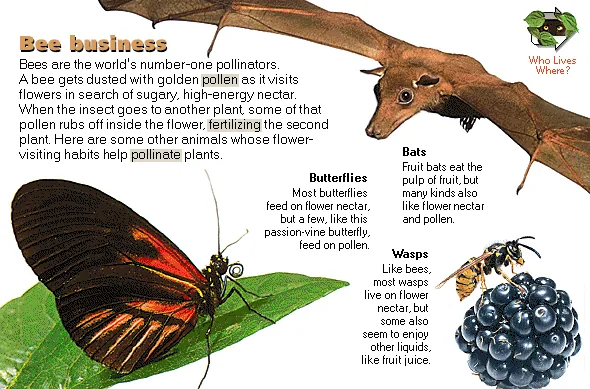
Bees are the world's number-one pollinators. A bee gets dusted with golden pollen as it visits flowers in search of sugary, high-energy nectar. When the insect goes to another plant, some of that pollen rubs off inside the flower, fertilizing the second plant. Here are some other animals whose flower-visiting habits help pollinate plants.

ButterfliesMost butterflies feed on flower nectar, but a few, like this passion-vine butterfly, feed on pollen.
BatsFruit bats eat the pulp of fruit, but many kinds also like flower nectar and pollen.
WaspsLike bees, most wasps live on flower nectar, but some also seem to enjoy other liquids, like fruit juice.
Special signals

Special signals

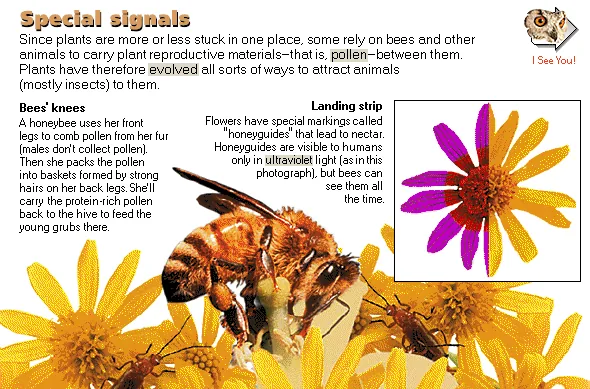
Since plants are more or less stuck in one place, some rely on bees and other animals to carry plant reproductive materials—that is, pollen—between them. Plants have therefore evolved all sorts of ways to attract animals (mostly insects) to them.

Bees' kneesA honeybee uses her front legs to comb pollen from her fur (males don't collect pollen). Then she packs the pollen into baskets formed by strong hairs on her back legs. She'll carry the protein-rich pollen back to the hive to feed the young grubs there.
Landing stripFlowers have special markings called "honeyguides" that lead to nectar. Honeyguides are visible to humans only in ultraviolet light (as in this photograph), but bees can see them all the time.

Watch

Too defensive! — Most honeybees aren't very happy in steamy, wet weather. The African honeybees from which killer bees are descended evolved in a hot climate, and they don't mind high temperatures. That's why scientists thought they'd be good bees to have in tropical Brazil but it hasn't worked out that way. Killer bees are too quick to attack when anyone approaches their nest.

Source: Microsoft Dangerous Creatures (1994) CD-ROM. Text liberated from original screen art; images & clip restored from disc. Original media is Microsoft/supplier copyright — placeholder pending swap to open-licensed assets. Credits & Acknowledgements →