Dangerous Creatures
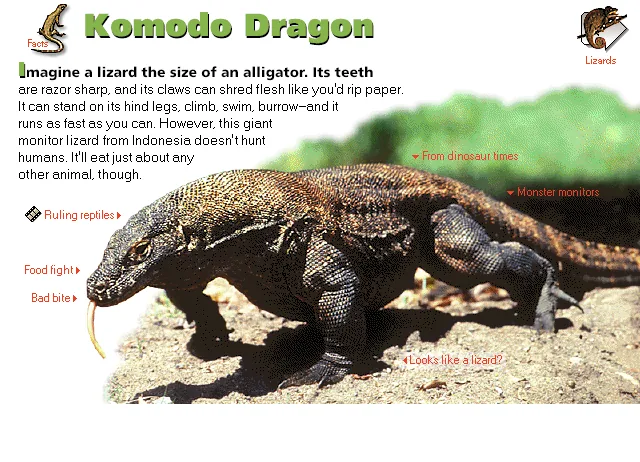
Komodo Dragon
Komodo Dragon
Varanus komodoensis

The world's biggest lizard claws, climbs, swims, and runs — and its bacteria-loaded bite is deadlier than venom!

Imagine a lizard the size of an alligator. Its teeth are razor sharp, and its claws can shred flesh like you'd rip paper. It can stand on its hind legs, climb, swim, burrow–and it runs as fast as you can. However, this giant monitor lizard from Indonesia doesn't hunt humans. It'll eat just about any other animal, though.

Get closer

From dinosaur times

From dinosaur times

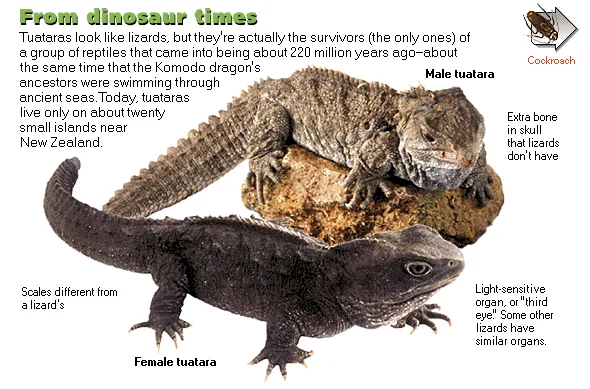
Tuataras look like lizards, but they're actually the survivors (the only ones) of a group of reptiles that came into being about 220 million years ago–about the same time that the Komodo dragon's ancestors were swimming through ancient seas. Today, tuataras live only on about twenty small islands near New Zealand.

Male tuataraExtra bone in skull that lizards don't have. Light-sensitive organ, or "third eye." Some other lizards have similar organs.
Female tuataraScales different from a lizard's.
Food fight

Food fight

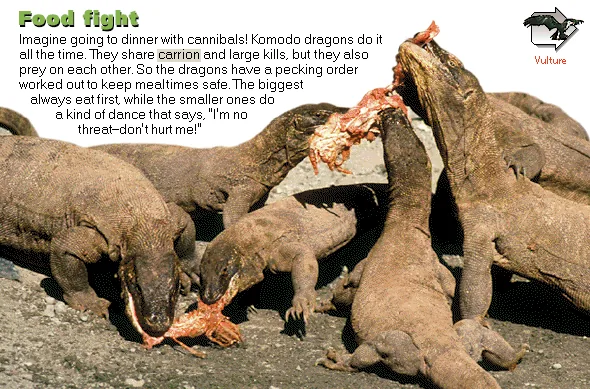
Imagine going to dinner with cannibals! Komodo dragons do it all the time. They share carrion and large kills, but they also prey on each other. So the dragons have a pecking order worked out to keep mealtimes safe. The biggest always eat first, while the smaller ones do a kind of dance that says, "I'm no threat–don't hurt me!"

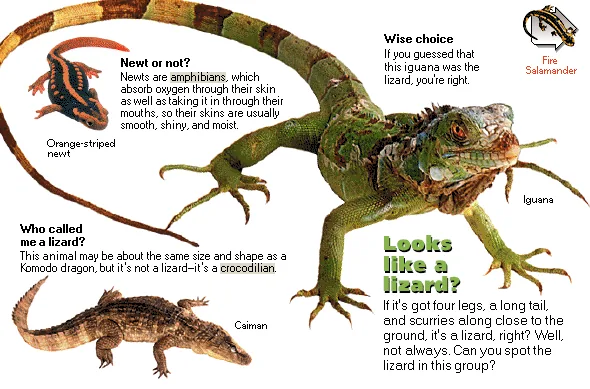
Looks like a lizard?

Looks like a lizard?

If it's got four legs, a long tail, and scurries along close to the ground, it's a lizard, right? Well, not always. Can you spot the lizard in this group?

Newt or not?Newts are amphibians, which absorb oxygen through their skin as well as taking it in through their mouths, so their skins are usually smooth, shiny, and moist.
Who called me a lizard?This animal may be about the same size and shape as a Komodo dragon, but it's not a lizard–it's a crocodilian.
Wise choiceIf you guessed that this iguana was the lizard, you're right.
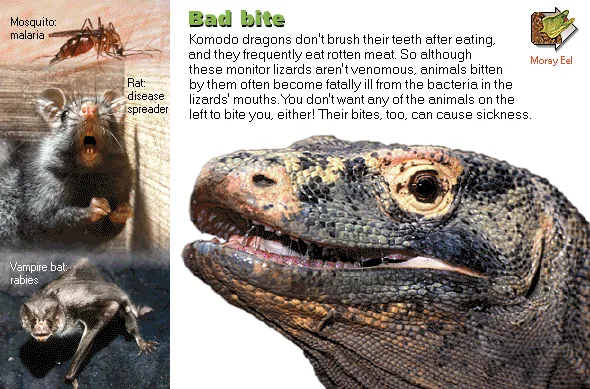
Bad bite

Bad bite

Komodo dragons don't brush their teeth after eating, and they frequently eat rotten meat. So although these monitor lizards aren't venomous, animals bitten by them often become fatally ill from the bacteria in the lizards' mouths. You don't want any of the animals on the left to bite you, either! Their bites, too, can cause sickness.

Mosquitomalaria
Ratdisease spreader
Vampire batrabies
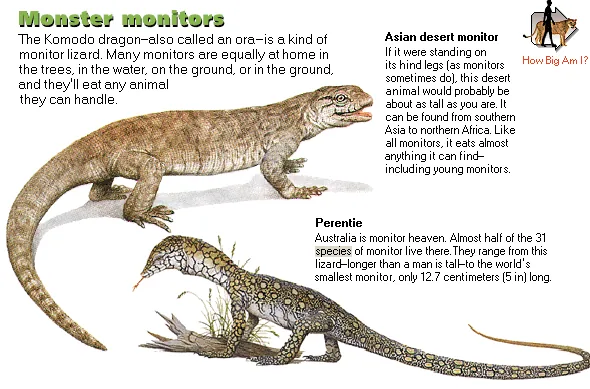
Monster monitors

Monster monitors

The Komodo dragon–also called an ora–is a kind of monitor lizard. Many monitors are equally at home in the trees, in the water, on the ground, or in the ground, and they'll eat any animal they can handle.

Asian desert monitorIf it were standing on its hind legs (as monitors sometimes do), this desert animal would probably be about as tall as you are. It can be found from southern Asia to northern Africa. Like all monitors, it eats almost anything it can find–including young monitors.
PerentieAustralia is monitor heaven. Almost half of the 31 species of monitor live there. They range from this lizard–longer than a man is tall–to the world's smallest monitor, only 12.7 centimeters (5 in) long.

Watch

Ruling reptiles — Komodo dragons live only on one small group of islands in Indonesia. The dragons are the largest predators–and the largest scavengers–on these islands. They are living reminders of a time when giant reptiles ruled the earth.

Source: Microsoft Dangerous Creatures (1994) CD-ROM. Text liberated from original screen art; images & clip restored from disc. Original media is Microsoft/supplier copyright — placeholder pending swap to open-licensed assets. Credits & Acknowledgements →