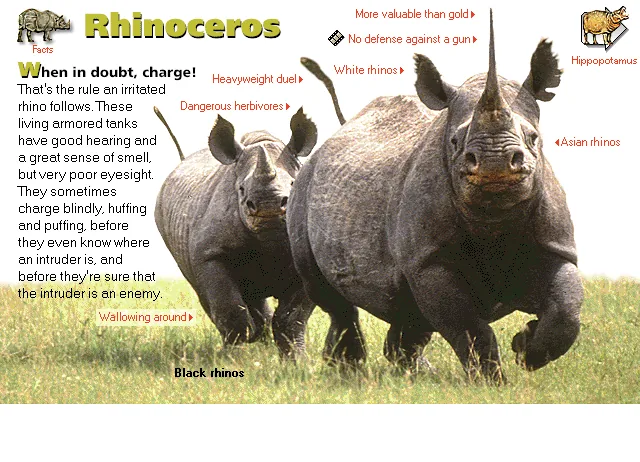
That's the rule an irritated rhino follows. These living armored tanks have good hearing and a great sense of smell, but very poor eyesight. They sometimes charge blindly, huffing and puffing, before they even know where an intruder is, and before they're sure that the intruder is an enemy.
Get closer
Heavyweight duel
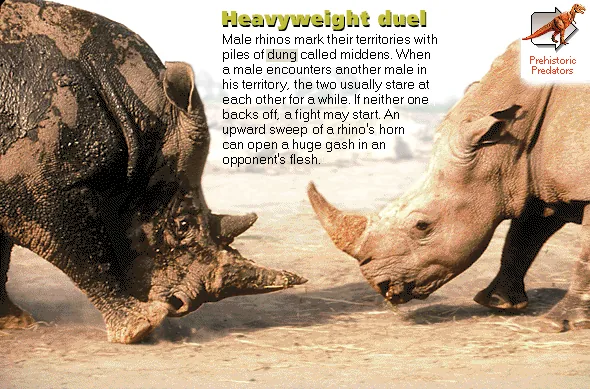
Male rhinos mark their territories with piles of dung called middens. When a male encounters another male in his territory, the two usually stare at each other for a while. If neither one backs off, a fight may start. An upward sweep of a rhino's horn can open a huge gash in an opponent's flesh.
White rhinos
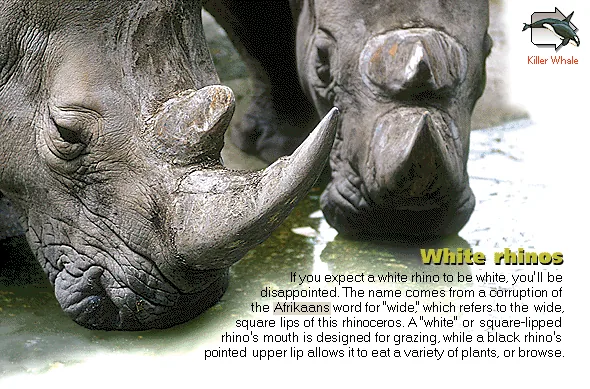
If you expect a white rhino to be white, you'll be disappointed. The name comes from a corruption of the Afrikaans word for "wide," which refers to the wide, square lips of this rhinoceros. A "white" or square-lipped rhino's mouth is designed for grazing, while a black rhino's pointed upper lip allows it to eat a variety of plants, or browse.
Wallowing around
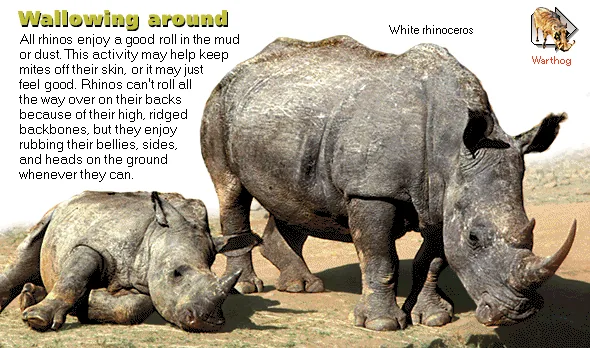
All rhinos enjoy a good roll in the mud or dust. This activity may help keep mites off their skin, or it may just feel good. Rhinos can't roll all the way over on their backs because of their high, ridged backbones, but they enjoy rubbing their bellies, sides, and heads on the ground whenever they can.
White rhinocerosWhite rhinoceros
More valuable than gold
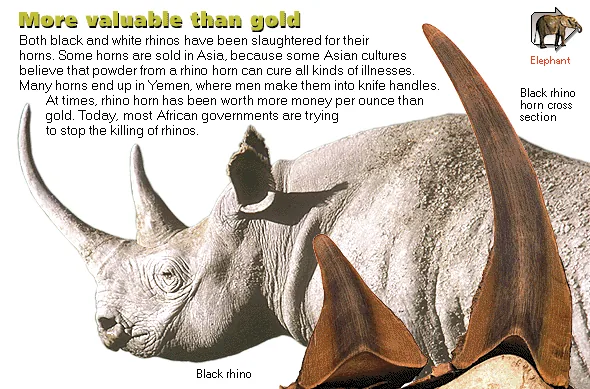
Both black and white rhinos have been slaughtered for their horns. Some horns are sold in Asia, because some Asian cultures believe that powder from a rhino horn can cure all kinds of illnesses. Many horns end up in Yemen, where men make them into knife handles. At times, rhino horn has been worth more money per ounce than gold. Today, most African governments are trying to stop the killing of rhinos.
Horn cross sectionBlack rhino horn cross section
Dangerous herbivores
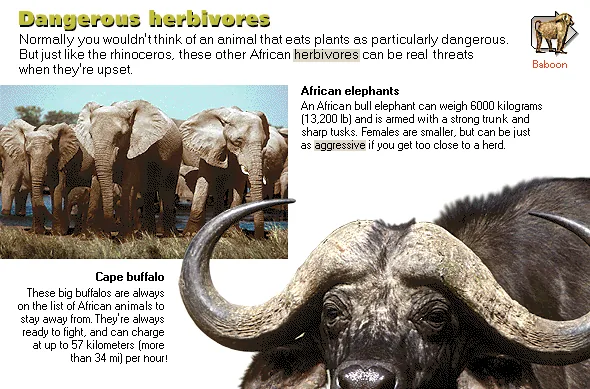
Normally you wouldn't think of an animal that eats plants as particularly dangerous. But just like the rhinoceros, these other African herbivores can be real threats when they're upset.
African elephantsAn African bull elephant can weigh 6000 kilograms (13,200 lb) and is armed with a strong trunk and sharp tusks. Females are smaller, but can be just as aggressive if you get too close to a herd.
Cape buffaloThese big buffalos are always on the list of African animals to stay away from. They're always ready to fight, and can charge at up to 57 kilometers (more than 34 mi) per hour!
Asian rhinos
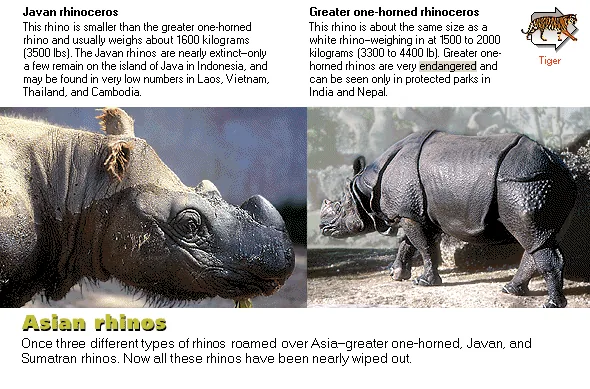
Once three different types of rhinos roamed over Asia–greater one-horned, Javan, and Sumatran rhinos. Now all these rhinos have been nearly wiped out.
Javan rhinocerosThis rhino is smaller than the greater one-horned rhino and usually weighs about 1600 kilograms (3500 lbs). The Javan rhinos are nearly extinct–only a few remain on the island of Java in Indonesia, and may be found in very low numbers in Laos, Vietnam, Thailand, and Cambodia.
Greater one-horned rhinocerosThis rhino is about the same size as a white rhino–weighing in at 1500 to 2000 kilograms (3300 to 4400 lb). Greater one-horned rhinos are very endangered and can be seen only in protected parks in India and Nepal.
Watch
No defense against a gun — Rhinos can weigh two or three tons, charge at 50 kilometers (31 mi) per hour, and they've even been known to ram their horns through the sides of trucks and trains. But all that power is no defense against the guns of poachers who kill rhinos for their horns.
Source: Microsoft Dangerous Creatures (1994) CD-ROM. Text liberated from original screen art; images & clip restored from disc. Original media is Microsoft/supplier copyright — placeholder pending swap to open-licensed assets. Credits & Acknowledgements →