Dangerous Creatures
Stingray
Stingray
Dasyatis pastinaca

One tail flick from this flat-bodied fish can drive a venomous spine right through your leg!

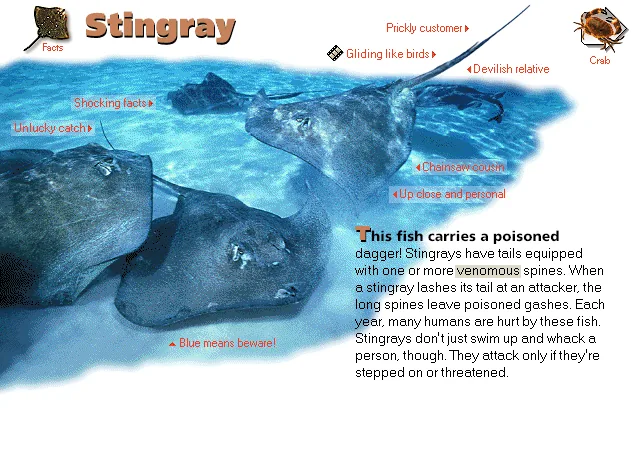
This fish carries a poisoned dagger! Stingrays have tails equipped with one or more venomous spines. When a stingray lashes its tail at an attacker, the long spines leave poisoned gashes. Each year, many humans are hurt by these fish. Stingrays don't just swim up and whack a person, though. They attack only if they're stepped on or threatened.

Get closer

Prickly customer

Prickly customer

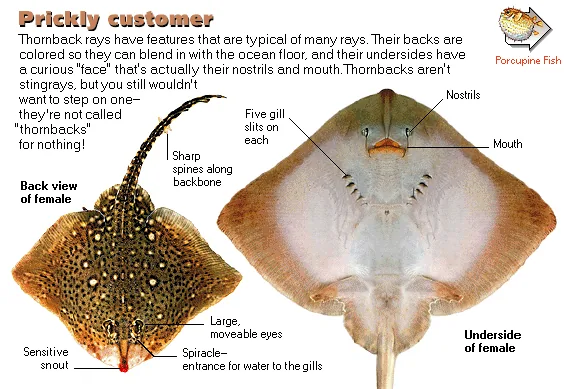
Thornback rays have features that are typical of many rays. Their backs are colored so they can blend in with the ocean floor, and their undersides have a curious "face" that's actually their nostrils and mouth. Thornbacks aren't stingrays, but you still wouldn't want to step on one—they're not called "thornbacks" for nothing!

Back view of femaleSharp spines along backbone, Large, moveable eyes, Sensitive snout, Spiracle—entrance for water to the gills
Underside of femaleFive gill slits on each, Nostrils, Mouth
Shocking facts

Shocking facts

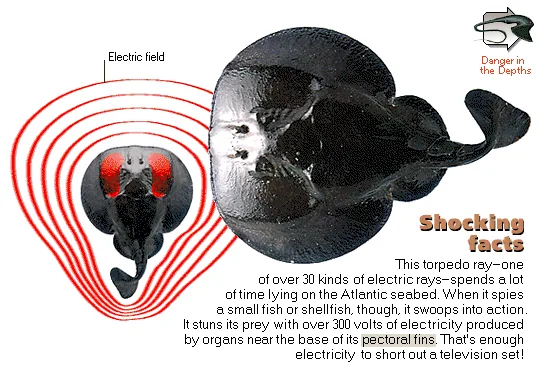
This torpedo ray—one of over 30 kinds of electric rays—spends a lot of time lying on the Atlantic seabed. When it spies a small fish or shellfish, though, it swoops into action. It stuns its prey with over 300 volts of electricity produced by organs near the base of its pectoral fins. That's enough electricity to short out a television set!

Electric fieldElectric field
Blue means beware!

Blue means beware!

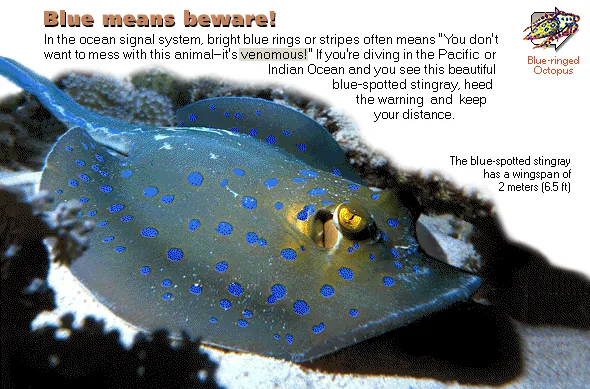
In the ocean signal system, bright blue rings or stripes often means "You don't want to mess with this animal—it's venomous!" If you're diving in the Pacific or Indian Ocean and you see this beautiful blue-spotted stingray, heed the warning and keep your distance.

Blue-spotted stingrayThe blue-spotted stingray has a wingspan of 2 meters (6.5 ft)
Devilish relative

Devilish relative

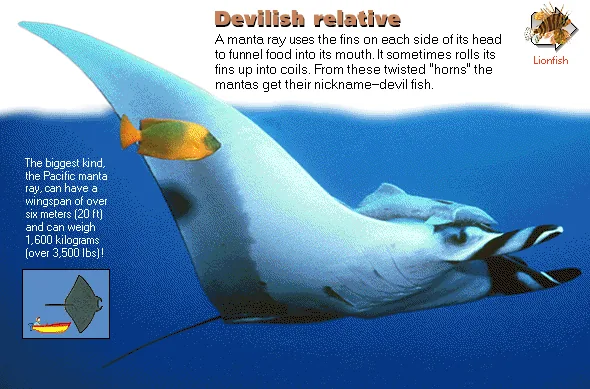
A manta ray uses the fins on each side of its head to funnel food into its mouth. It sometimes rolls its fins up into coils. From these twisted "horns" the mantas get their nickname—devil fish.

Pacific manta rayThe biggest kind, the Pacific manta ray, can have a wingspan of over six meters (20 ft) and can weigh 1,600 kilograms (over 3,500 lbs)!
Up close and personal

Up close and personal

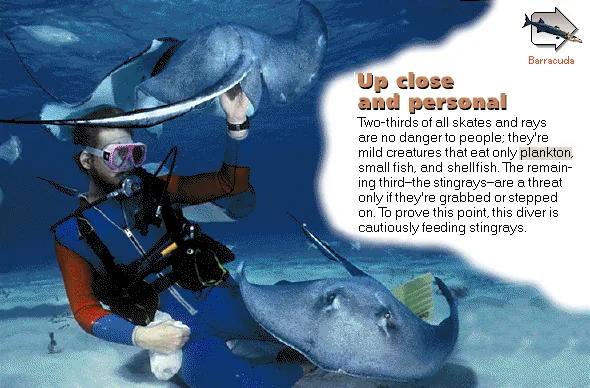
Two-thirds of all skates and rays are no danger to people; they're mild creatures that eat only plankton, small fish, and shellfish. The remaining third—the stingrays—are a threat only if they're grabbed or stepped on. To prove this point, this diver is cautiously feeding stingrays.

Unlucky catch

Unlucky catch

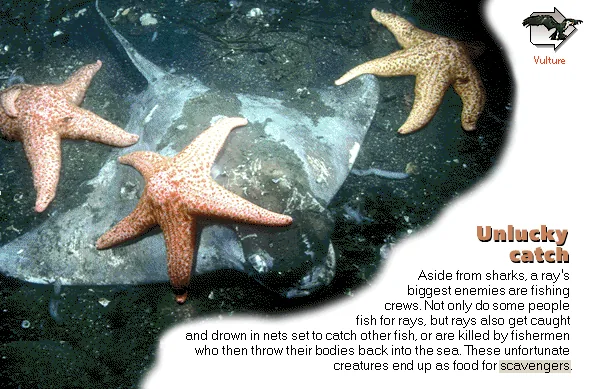
Aside from sharks, a ray's biggest enemies are fishing crews. Not only do some people fish for rays, but rays also get caught and drown in nets set to catch other fish, or are killed by fishermen who then throw their bodies back into the sea. These unfortunate creatures end up as food for scavengers.

Chainsaw cousin

Chainsaw cousin

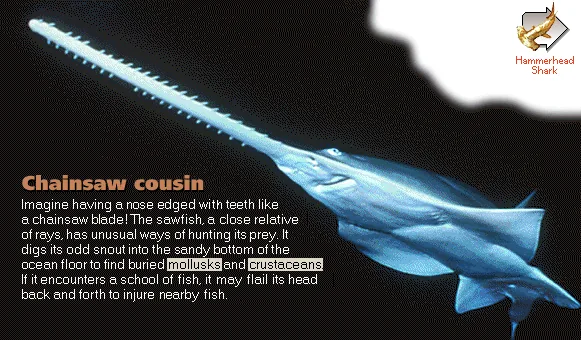
Imagine having a nose edged with teeth like a chainsaw blade! The sawfish, a close relative of rays, has unusual ways of hunting its prey. It digs its odd snout into the sandy bottom of the ocean floor to find buried mollusks and crustaceans. If it encounters a school of fish, it may flail its head back and forth to injure nearby fish.

Watch

Gliding like birds — Flying low: Stingrays usually flap along close to the sea floor, searching for shellfish to eat.

Source: Microsoft Dangerous Creatures (1994) CD-ROM. Text liberated from original screen art; images & clip restored from disc. Original media is Microsoft/supplier copyright — placeholder pending swap to open-licensed assets. Credits & Acknowledgements →