Dangerous Creatures
Australian Sea Wasp
Australian Sea Wasp
Chironex fleckeri

One touch from this nearly invisible jellyfish can kill you before you reach the shore.

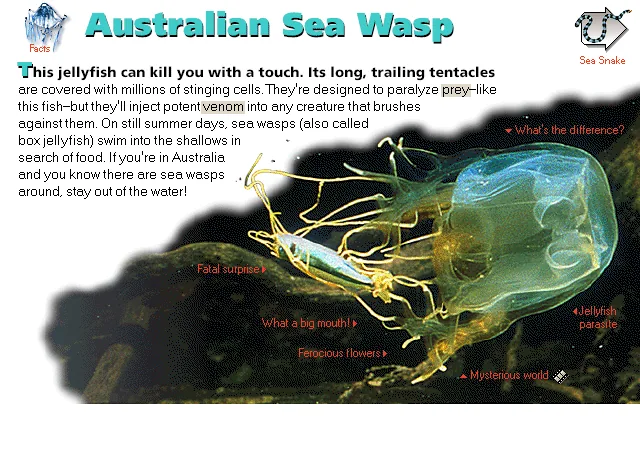
This jellyfish can kill you with a touch. Its long, trailing tentacles are covered with millions of stinging cells. They're designed to paralyze prey–like this fish–but they'll inject potent venom into any creature that brushes against them. On still summer days, sea wasps (also called box jellyfish) swim into the shallows in search of food. If you're in Australia and you know there are sea wasps around, stay out of the water!

Get closer

What's the difference?

What's the difference?

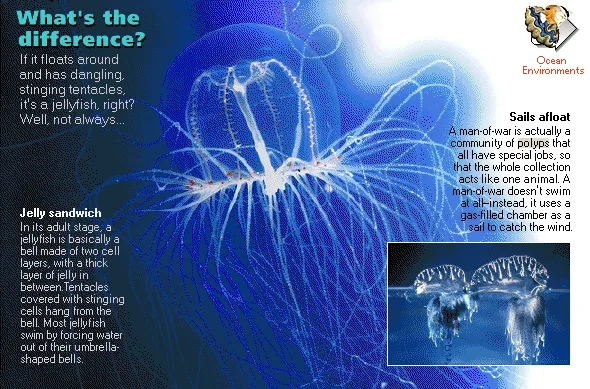
If it floats around and has dangling, stinging tentacles, it's a jellyfish, right? Well, not always...

Jelly sandwichIn its adult stage, a jellyfish is basically a bell made of two cell layers, with a thick layer of jelly in between Tentacles covered with stinging cells hang from the bell. Most jellyfish swim by forcing water out of their umbrella-shaped bells.
Sails afloatA man-of-war is actually a community of polyps that all have special jobs, so that the whole collection acts like one animal. A man-of-war doesn't swim at all–instead, it uses a gas-filled chamber as a sail to catch the wind.
Ferocious flower

Ferocious flower

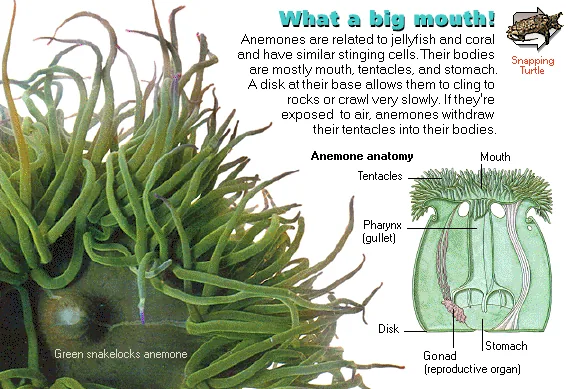
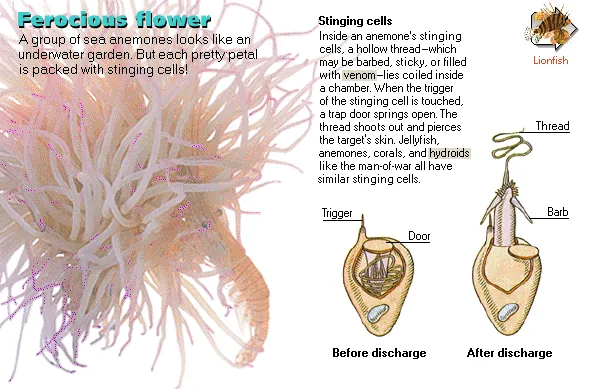
A group of sea anemones looks like an underwater garden. But each pretty petal is packed with stinging cells!

Stinging cellsInside an anemone's stinging cells, a hollow thread–which may be barbed, sticky, or filled with venom–lies coiled inside a chamber. When the trigger of the stinging cell is touched, a trap door springs open. The thread shoots out and pierces the target's skin. Jellyfish, anemones, corals, and hydroids like the man-of-war all have similar stinging cells.
What a big mouth!

What a big mouth!

Anemones are related to jellyfish and coral and have similar stinging cells. Their bodies are mostly mouth, tentacles, and stomach. A disk at their base allows them to cling to rocks or crawl very slowly. If they're exposed to air, anemones withdraw their tentacles into their bodies.

Fatal surprise

Fatal surprise

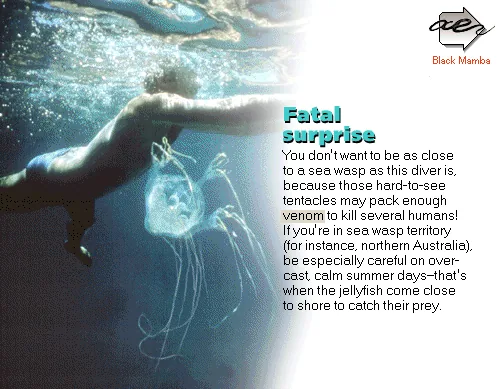
You don't want to be as close to a sea wasp as this diver is, because those hard-to-see tentacles may pack enough venom to kill several humans! If you're in sea wasp territory (for instance, northern Australia), be especially careful on overcast, calm summer days–that's when the jellyfish come close to shore to catch their prey.

Jellyfish parasite

Jellyfish parasite

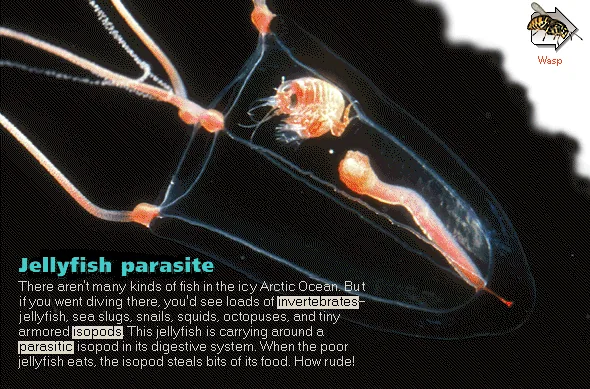
There aren't many kinds of fish in the icy Arctic Ocean. But if you went diving there, you'd see loads of invertebrates: jellyfish, sea slugs, snails, squids, octopuses, and tiny armored isopods. This jellyfish is carrying around a parasitic isopod in its digestive system. When the poor jellyfish eats, the isopod steals bits of its food. How rude!

Watch

Mysterious world — In the oceans there are all kinds of creatures that seem like alien beings to us. Sea pens and anemones that look like plants; jellyfish whose bodies you can see right through; fish and plankton that glow in the dark. And there are no doubt sea creatures that we've never even seen–for humans, the ocean is mostly an unexplored frontier.

Source: Microsoft Dangerous Creatures (1994) CD-ROM. Text liberated from original screen art; images & clip restored from disc. Original media is Microsoft/supplier copyright — placeholder pending swap to open-licensed assets. Credits & Acknowledgements →