Dangerous Creatures
Wasp
Wasp
Vespula vulgaris

Over 100,000 kinds—and every one means business!

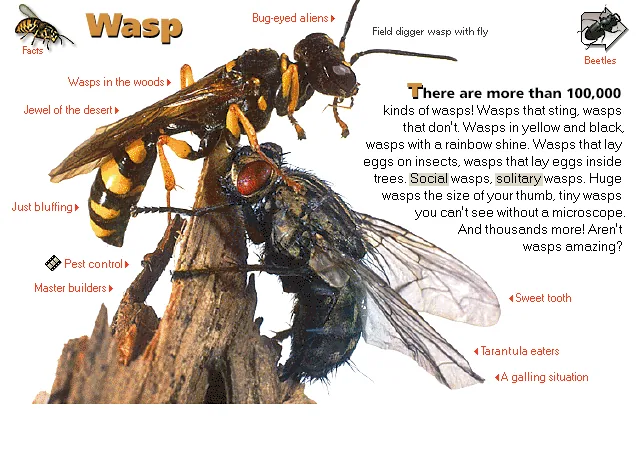
There are more than 100,000 kinds of wasps! Wasps that sting, wasps that don't. Wasps in yellow and black, wasps with a rainbow shine. Wasps that lay eggs on insects, wasps that lay eggs inside trees. Social wasps, solitary wasps. Huge wasps the size of your thumb, tiny wasps you can't see without a microscope. And thousands more! Aren't wasps amazing?

Get closer

Jewel of the desert

Jewel of the desert

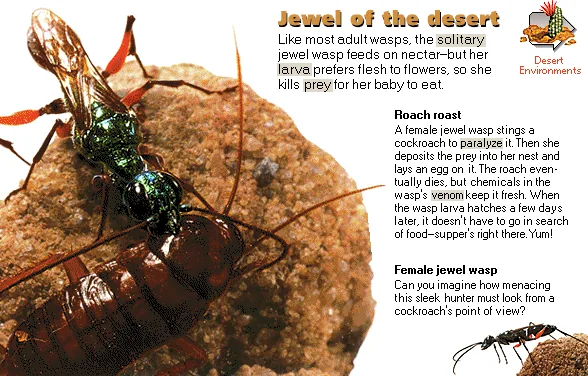
Like most adult wasps, the solitary jewel wasp feeds on nectar–but her larva prefers flesh to flowers, so she kills prey for her baby to eat.

Roach roastA female jewel wasp stings a cockroach to paralyze it. Then she deposits the prey into her nest and lays an egg on it. The roach eventually dies, but chemicals in the wasp's venom keep it fresh. When the wasp larva hatches a few days later, it doesn't have to go in search of food–supper's right there. Yum!
Female jewel waspCan you imagine how menacing this sleek hunter must look from a cockroach's point of view?
Wasps in the woods

Wasps in the woods

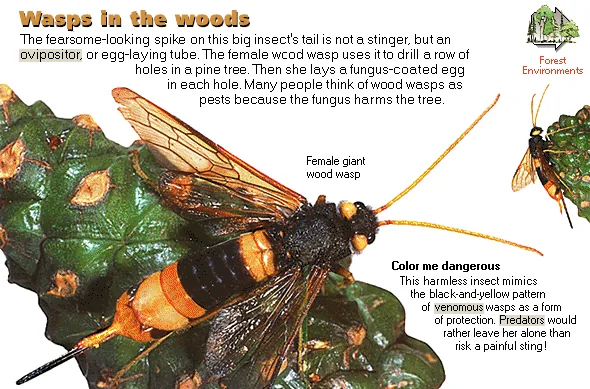
The fearsome-looking spike on this big insect's tail is not a stinger, but an ovipositor, or egg-laying tube. The female wood wasp uses it to drill a row of holes in a pine tree. Then she lays a fungus-coated egg in each hole. Many people think of wood wasps as pests because the fungus harms the tree.

Color me dangerousThis harmless insect mimics the black-and-yellow pattern of venomous wasps as a form of protection. Predators would rather leave her alone than risk a painful sting!
Master builders

Master builders

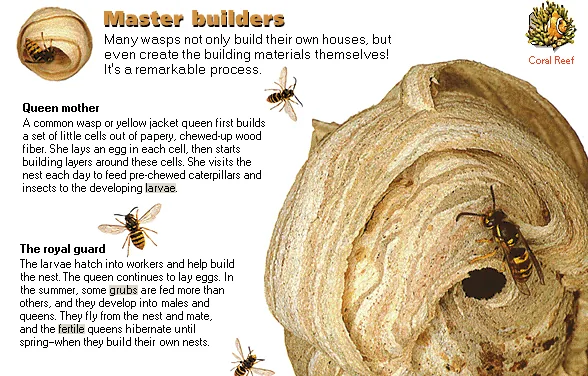
Many wasps not only build their own houses, but even create the building materials themselves! It's a remarkable process.

Queen motherA common wasp or yellow jacket queen first builds a set of little cells out of papery, chewed-up wood fiber. She lays an egg in each cell, then starts building layers around these cells. She visits the nest each day to feed pre-chewed caterpillars and insects to the developing larvae.
The royal guardThe larvae hatch into workers and help build the nest. The queen continues to lay eggs. In the summer, some grubs are fed more than others, and they develop into males and queens. They fly from the nest and mate, and the fertile queens hibernate until spring–when they build their own nests.
Sweet tooth

Sweet tooth

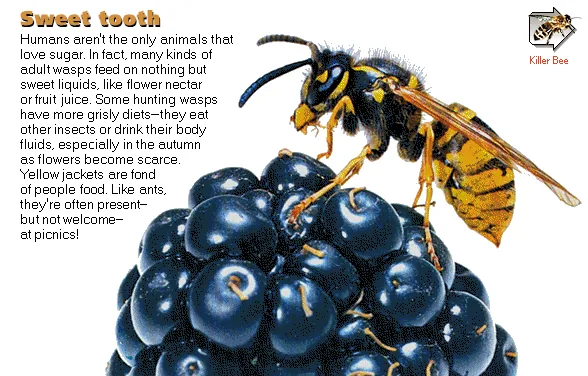
Humans aren't the only animals that love sugar. In fact, many kinds of adult wasps feed on nothing but sweet liquids, like flower nectar or fruit juice. Some hunting wasps have more grisly diets–they eat other insects or drink their body fluids, especially in the autumn as flowers become scarce. Yellow jackets are fond of people food. Like ants, they're often present–but not welcome–at picnics!

A galling situation

A galling situation

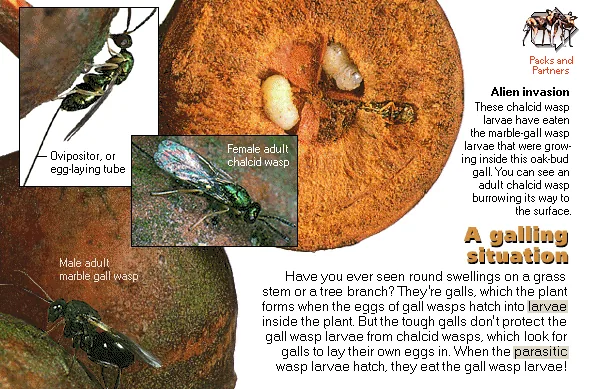
Have you ever seen round swellings on a grass stem or a tree branch? They're galls, which the plant forms when the eggs of gall wasps hatch into larvae inside the plant. But the tough galls don't protect the gall wasp larvae from chalcid wasps, which look for galls to lay their own eggs in. When the parasitic wasp larvae hatch, they eat the gall wasp larvae!

Alien invasionThese chalcid wasp larvae have eaten the marble-gall wasp larvae that were growing inside this oak-bud gall. You can see an adult chalcid wasp burrowing its way to the surface.
Just bluffing

Just bluffing

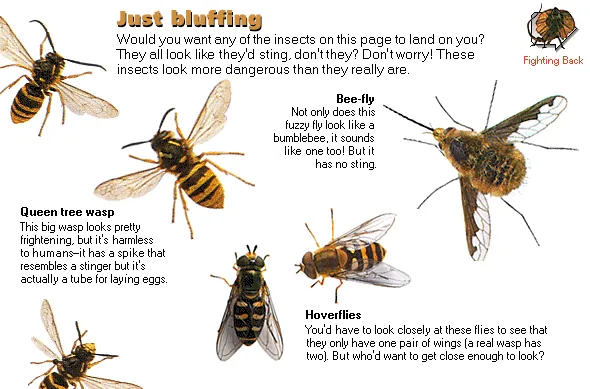
Would you want any of the insects on this page to land on you? They all look like they'd sting, don't they? Don't worry! These insects look more dangerous than they really are.

Bee-flyNot only does this fuzzy fly look like a bumblebee, it sounds like one too! But it has no sting.
Queen tree waspThis big wasp looks pretty frightening, but it's harmless to humans–it has a spike that resembles a stinger but it's actually a tube for laying eggs.
HoverfliesYou'd have to look closely at these flies to see that they only have one pair of wings (a real wasp has two). But who'd want to get close enough to look?
Bug-eyed aliens

Bug-eyed aliens

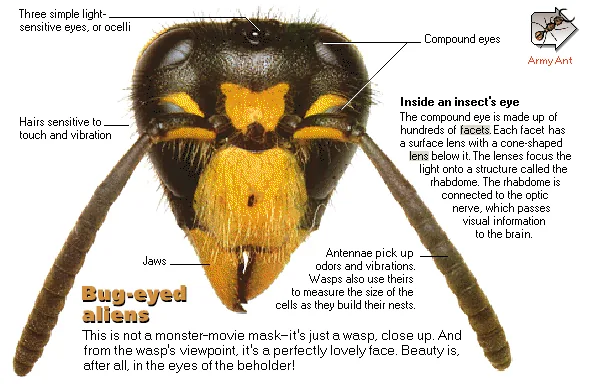
This is not a monster-movie mask–it's just a wasp, close up. And from the wasp's viewpoint, it's a perfectly lovely face. Beauty is, after all, in the eyes of the beholder!

Inside an insect's eyeThe compound eye is made up of hundreds of facets. Each facet has a surface lens with a cone-shaped lens below it. The lenses focus the light onto a structure called the rhabdome. The rhabdome is connected to the optic nerve, which passes visual information to the brain.

Watch

Pest control — All female adult wasps feed other insects to their young. Wasps that live in groups, like yellow jackets, will kill any insect they can grab. Wasps that live alone, like the ones shown here, tend to hunt for very specific prey, like a particular caterpillar or beetle. These solitary wasps are sometimes imported by farmers to control pests that are destructive to crops.

Source: Microsoft Dangerous Creatures (1994) CD-ROM. Text liberated from original screen art; images & clip restored from disc. Original media is Microsoft/supplier copyright — placeholder pending swap to open-licensed assets. Credits & Acknowledgements →