Dangerous Creatures
Cape Hunting Dog
Cape Hunting Dog
Lycaon pictus

The most successful pack hunters in Africa—they almost never miss!

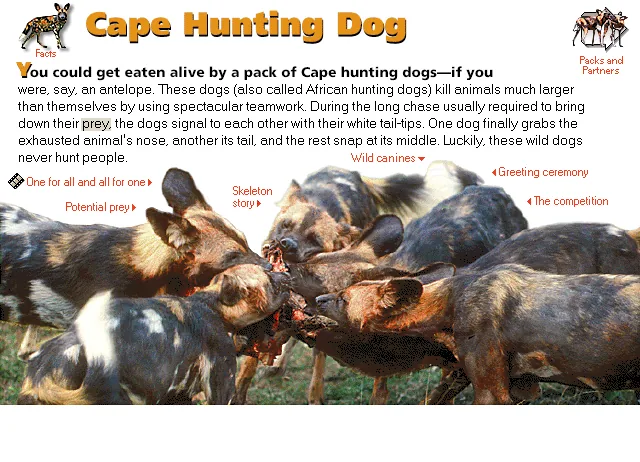
You could get eaten alive by a pack of Cape hunting dogs—if you were, say, an antelope. These dogs (also called African hunting dogs) kill animals much larger than themselves by using spectacular teamwork. During the long chase usually required to bring down their prey, the dogs signal to each other with their white tail-tips. One dog finally grabs the exhausted animal's nose, another its tail, and the rest snap at its middle. Luckily, these wild dogs never hunt people.

Get closer

Skeleton story

Skeleton story

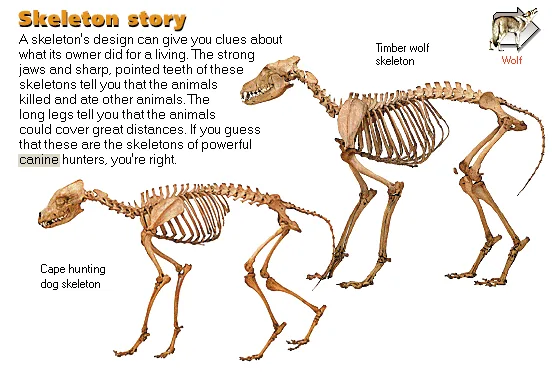
A skeleton's design can give you clues about what its owner did for a living. The strong jaws and sharp, pointed teeth of these skeletons tell you that the animals killed and ate other animals. The long legs tell you that the animals could cover great distances. If you guess that these are the skeletons of powerful canine hunters, you're right.

Cape hunting dog skeletonCape hunting dog skeleton
Timber wolf skeletonTimber wolf skeleton
Potential prey

Potential prey

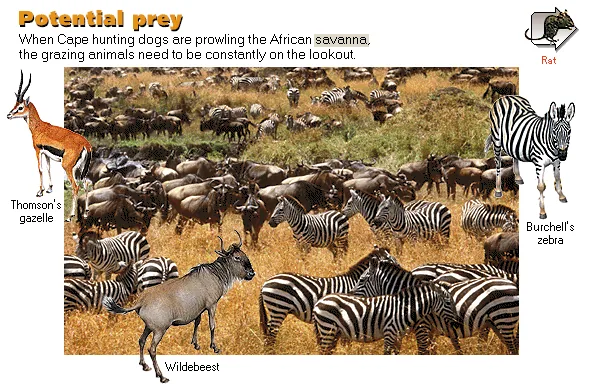
When Cape hunting dogs are prowling the African savanna, the grazing animals need to be constantly on the lookout.

Thomson's gazelleThomson's gazelle
WildebeestWildebeest
Burchell's zebraBurchell's zebra
The competition

The competition

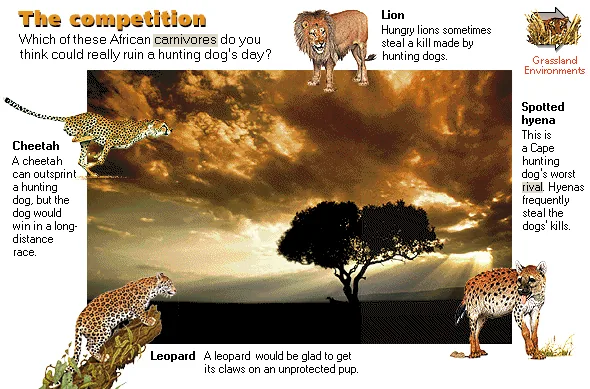
Which of these African carnivores do you think could really ruin a hunting dog's day?

CheetahA cheetah can outsprint a hunting dog, but the dog would win in a long-distance race.
LionHungry lions sometimes steal a kill made by hunting dogs.
Spotted hyenaThis is a Cape hunting dog's worst rival. Hyenas frequently steal the dogs' kills.
LeopardA leopard would be glad to get its claws on an unprotected pup.
Wild canines

Wild canines

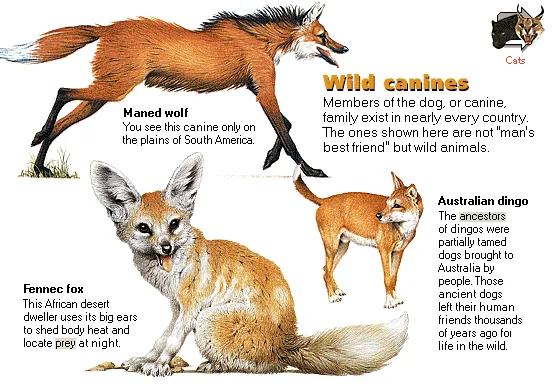
Members of the dog, or canine, family exist in nearly every country. The ones shown here are not "man's best friend" but wild animals.

Maned wolfYou see this canine only on the plains of South America.
Fennec foxThis African desert dweller uses its big ears to shed body heat and locate prey at night.
Australian dingoThe ancestors of dingos were partially tamed dogs brought to Australia by people. Those ancient dogs left their human friends thousands of years ago for life in the wild.
Greeting ceremony

Greeting ceremony

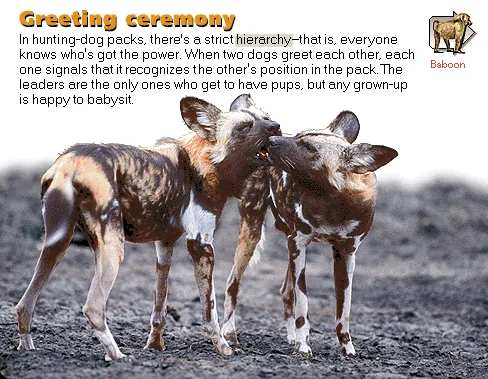
In hunting-dog packs, there's a strict hierarchy—that is, everyone knows who's got the power. When two dogs greet each other, each one signals that it recognizes the other's position in the pack. The leaders are the only ones who get to have pups, but any grown-up is happy to babysit.

Watch

One for all and all for one — A Cape hunting dog is not a very big animal. And it doesn't have claws or poison that it can use to wound its prey. To be well-fed carnivores on the African savanna, hunting dogs must live and hunt in packs.

Source: Microsoft Dangerous Creatures (1994) CD-ROM. Text liberated from original screen art; images & clip restored from disc. Original media is Microsoft/supplier copyright — placeholder pending swap to open-licensed assets. Credits & Acknowledgements →