Dangerous Creatures
Lionfish
Lionfish
Pterois volitans

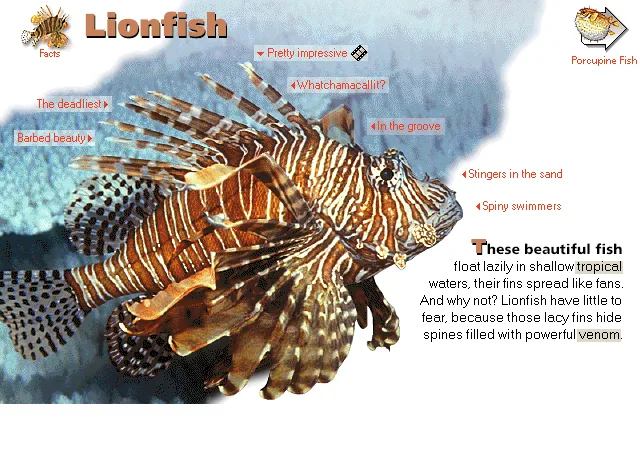
Beautiful and deadly, the lionfish hides lethal venom inside its gorgeous, fan-like fins.

These beautiful fish float lazily in shallow tropical waters, their fins spread like fans. And why not? Lionfish have little to fear, because those lacy fins hide spines filled with powerful venom.

Get closer

In the groove

In the groove

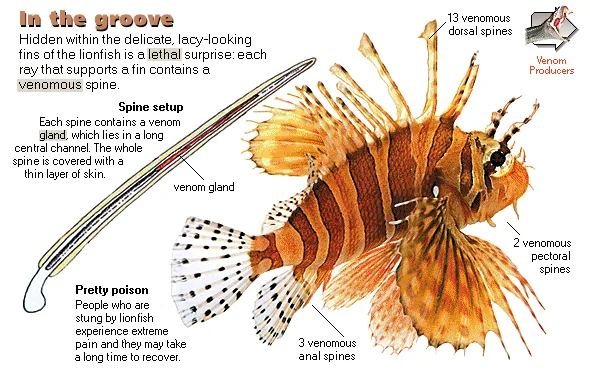
Hidden within the delicate, lacy-looking fins of the lionfish is a lethal surprise: each ray that supports a fin contains a venomous spine.

Spine setupEach spine contains a venom gland, which lies in a long central channel. The whole spine is covered with a thin layer of skin.
Pretty poisonPeople who are stung by lionfish experience extreme pain and they may take a long time to recover.
Whatchamacallit

Whatchamacallit

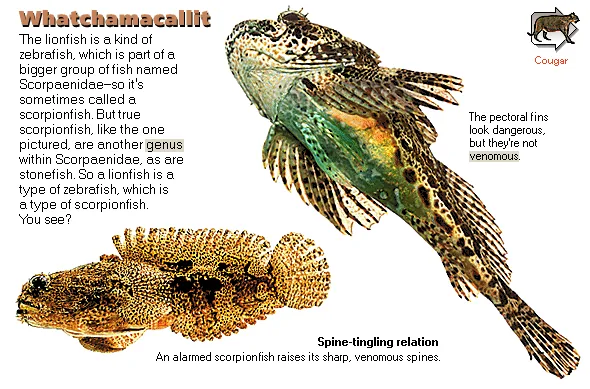
The lionfish is a kind of zebrafish, which is part of a bigger group of fish named Scorpaenidae—so it's sometimes called a scorpionfish. But true scorpionfish, like the one pictured, are another genus within Scorpaenidae, as are stonefish. So a lionfish is a type of zebrafish, which is a type of scorpionfish. You see?

Spine-tingling relationAn alarmed scorpionfish raises its sharp, venomous spines.
Stingers in the sand

Stingers in the sand

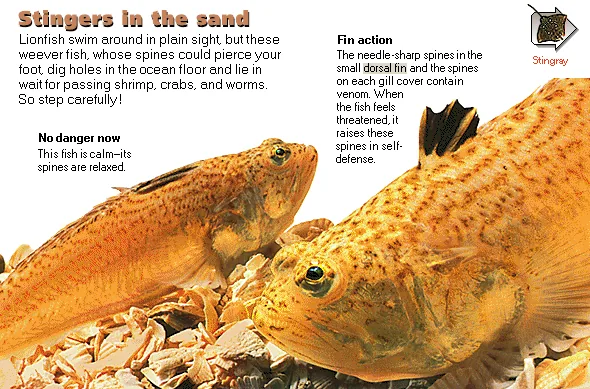
Lionfish swim around in plain sight, but these weever fish, whose spines could pierce your foot, dig holes in the ocean floor and lie in wait for passing shrimp, crabs, and worms. So step carefully!

No danger nowThis fish is calm—its spines are relaxed.
Fin actionThe needle-sharp spines in the small dorsal fin and the spines on each gill cover contain venom. When the fish feels threatened, it raises these spines in self-defense.
Spiny swimmers

Spiny swimmers

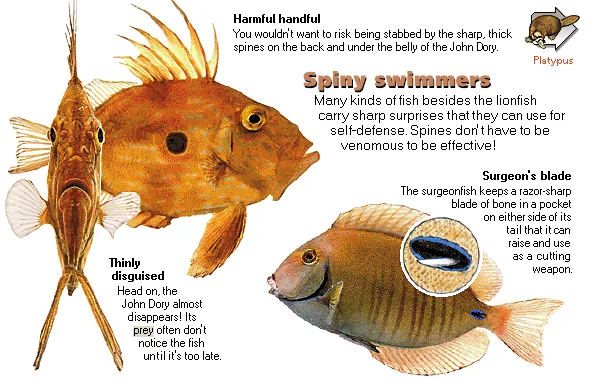
Many kinds of fish besides the lionfish carry sharp surprises that they can use for self-defense. Spines don't have to be venomous to be effective!

Thinly disguisedHead on, the John Dory almost disappears! Its prey often don't notice the fish until it's too late.
Harmful handfulYou wouldn't want to risk being stabbed by the sharp, thick spines on the back and under the belly of the John Dory.
Surgeon's bladeThe surgeonfish keeps a razor-sharp blade of bone in a pocket on either side of its tail that it can raise and use as a cutting weapon.
Barbed beauty

Barbed beauty

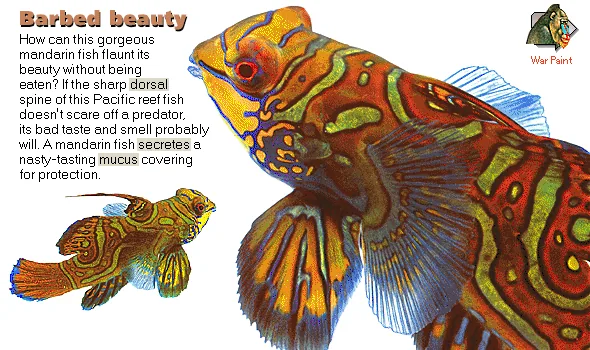
How can this gorgeous mandarin fish flaunt its beauty without being eaten? If the sharp dorsal spine of this Pacific reef fish doesn't scare off a predator, its bad taste and smell probably will. A mandarin fish secretes a nasty-tasting mucus covering for protection.

The deadliest

The deadliest

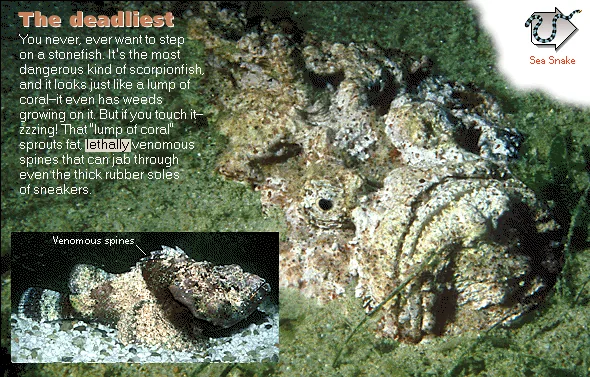
You never, ever want to step on a stonefish. It's the most dangerous kind of scorpionfish, and it looks just like a lump of coral—it even has weeds growing on it. But if you touch it—zzzing! That "lump of coral" sprouts fat, lethally venomous spines that can jab through even the thick rubber soles of sneakers.

Watch

Pretty impressive — Nearly everyone who has encountered a lionfish has been impressed by it. That's why it's been given so many different names: It's been called a lionfish because it's fierce; a firefish and a devilfish because it stings; and a zebrafish because it's striped. Some people call it a turkeyfish because of the way it spreads its fins out like a male turkey proudly displaying its tail feathers.

Source: Microsoft Dangerous Creatures (1994) CD-ROM. Text liberated from original screen art; images & clip restored from disc. Original media is Microsoft/supplier copyright — placeholder pending swap to open-licensed assets. Credits & Acknowledgements →